Recycling Process Overview
Lead acid batteries are reprocessed in several stages:
- Intake and storage of batteries.
- Separation of the batteries into their component parts.
- Lead bearing components are processed further into lead bullion.
- Non lead bearing components are either processed further or sold.
- Refining of the lead bullion into lead alloys to meet customer requirements.
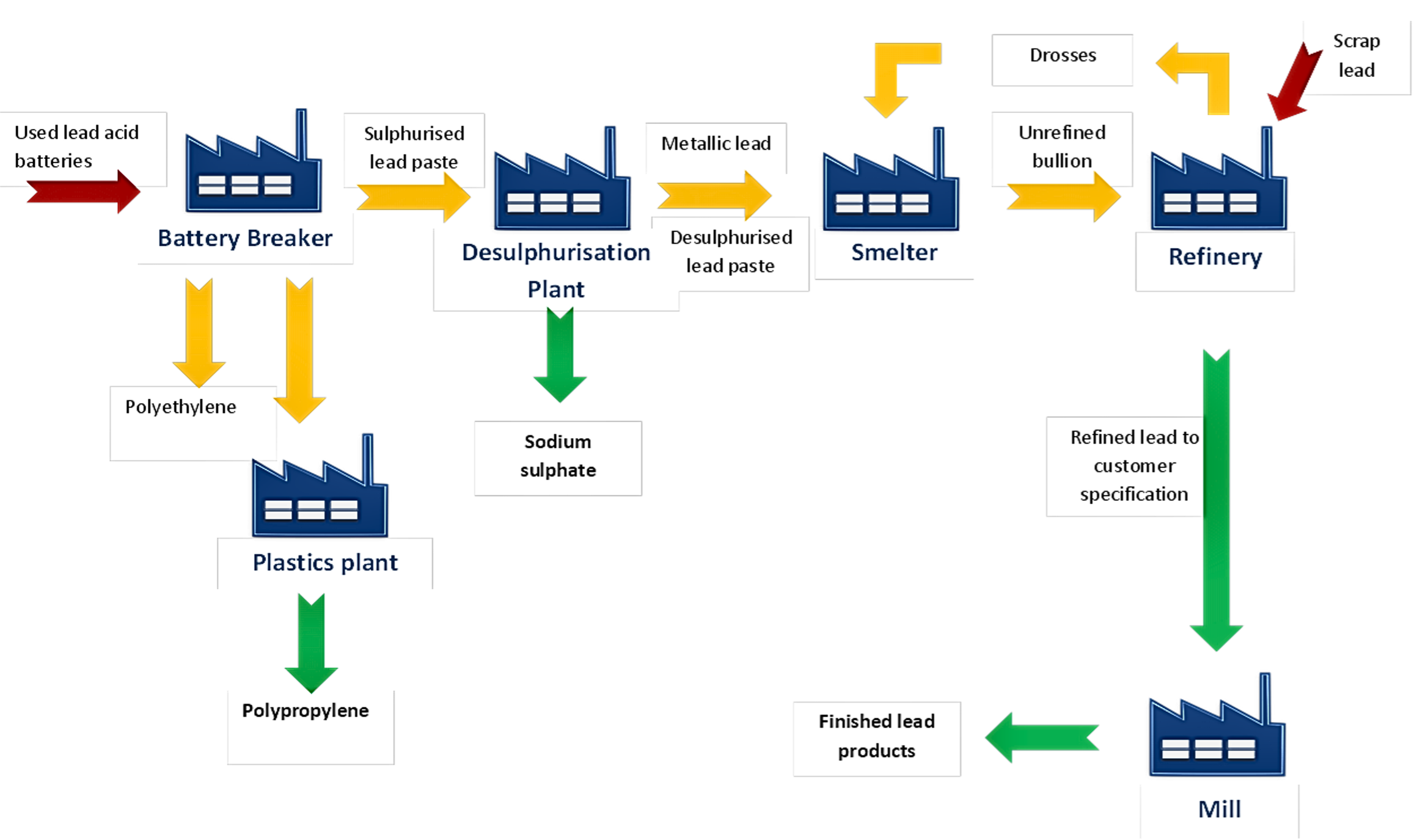
There are 3 main processing areas; battery breaker, smelter and refinery
The diagram below shows the process flow through each of these areas.
Battery Breaking process
The battery breaker takes in batteries and breaks them down into their constituent components. It also employs a de-sulphurisation process, which is unique to battery recycling in the UK and because it reduces the sulphur content of our raw materials & helps reduce our overall environmental impact.
Battery Breaking
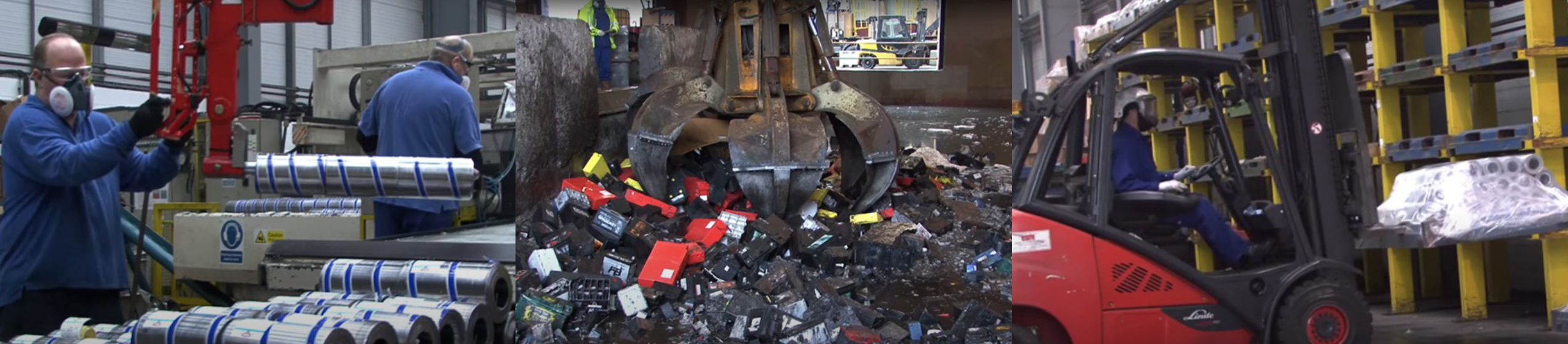
Batteries are delivered directly into a purpose-built warehouse, eliminating any risk of contamination. These batteries receive an initial ‘crush’, allowing the sulphuric acid to drain and be collected for further processing. They are then fed into a hammer mill to be broken up. The battery pieces are passed through a series of screens, “float/sink” tanks and filters to separate the metallic components, lead paste, polypropylene and other plastics. Metallic components are transferred into a separate storage area prior to furnace charging. The lead paste undergoes a desulphurisation process detailed below before being stored for furnace charging.
Polypropylene is separated from other plastic compounds and stored, before being granulated onsite and being sold to specialist recyclers. The other plastics, mainly polyethylene separators are washed and stored before being transferred off-site.
Paste de-sulphurisation
Battery paste is de-sulphurised using sodium carbonate before being stored ready for smelting. Previously collected battery acid is also converted to sodium sulphate in the same process. We sell sodium sulphate to the chemical industry for use as a bulking agent for washing powder.
Envirowales is the only plant in the UK to use this de-sulphurisation process. This has major environmental benefits significantly reducing any sulphur discharge, a major component of ‘acid rain’.
Smelting
The smelter takes the de-sulphurised paste and metallics produced by the battery breaker and converts them into lead bullion via means of two rotary furnaces. These are heated by oxygen enriched, natural gas burners, designed to reduce emissions from the combustion process. A chemical flux is added to aid the conversion reaction and help remove impurities from the resultant bullion. Envirowales monitors the process to ensure that peak efficiency is maintained.
The smelter department also receive dross produced by the refining process, which contain valuable metals such as Tin, Copper and Antimony. These are recovered by smelting the drosses, producing lead alloys with high percentages of these metals.
Lead bullion tapped from the furnace and the flux, which now resides as a slag, is also removed and is transferred to the refinery in molten form. Lead bullion/alloys can be cast into blocks at this stage if required.
Refining
Lead bullion produced by the smelting process is transferred into a processing kettle. Each kettle can hold 75-150 tonnes of molten lead and is heated via high efficiency natural gas burners. Emissions are controlled by dedicated extraction on each processing kettle.
Pyrometallurgical refining is undertaken with the lead in molten form. The chemical concept behind the refining process is the addition of reagents at controlled temperatures to remove impurities in the form of dross. Lead is produced in accordance with the British Standard Specification EN 12588 or Saturn Blei (German standard).
The dross produced is smelted to produce antimonial, tin and copper alloys which are sold to external organisations.
Scrap lead processing
The refining department has also been designed to process lead scrap. The initial phase of the site was solely processing lead scrap. Later phases introduced the smelter and battery breaker processes. Lead scrap is held in a dedicated storage bay and is melted in a 75-tonne kettle, designed to handle this raw material. The molten lead is then pumped into the refining kettles where they are pyrometallurgically processed until specific metallurgical requirements are achieved for the end user.
Casting
Once the lead has been refined to the appropriate customer requirements, the metal can be cast into various shapes and sizes, the most common being slabs of 8.4 tonnes and blocks of 1.6 and 1.7 tonnes.
Lead Sb Alloy ingots weighing between 25Kg to 35Kg are also produced.